
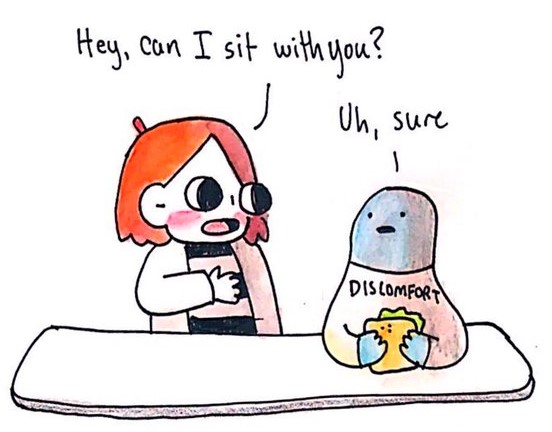
“Sitting with discomfort” has nothing to do with a chair.
Nor is it a description of how you feel after starting a new exercise program, or once the arthritis sets in.
It has everything to do with learning to be comfortable in the midst of discomfort.
“Sitting with discomfort” means being willing to stay put and face an uncomfortable discussion/situation/season/change instead of avoiding it.

That sounds ridiculous, doesn’t it? Why would anybody want to do that?
If you’ve ever had a root canal, the dentist probably asked you if you were ok before starting the procedure. Most of us say “yes”, even though we just received what felt like bee stings (shots of magic numbing juice) into our tender gums, we’re reclined at a weird angle, and we know we’re about to have to hold our mouth open for too long while the dentist drills into our head. We hope that the magic numbing juice lasts until the root canal is over.

Dentist: You OK?
Me, answering with my mouth wide open while dentist works: Yuph! Yuss hine! (Translation: Yup! Just fine!)
I mean, I’m really NOT feeling OK sitting there waiting for the root canal to commence, but I know I need to face it and get it done. It’s not fun, and we wouldn’t choose that for date night or anything, but we do it.
We sit with that discomfort until it’s over.
And think about this: we actually pay them to do that to us! #Who’sTheSmartOneHere?
Right now, the world over is feeling a TON of anxiety. Worry. Fear. Overwhelm-ment (If it’s not a word it should be.)

The solution is not to make these things go away. (You can’t.)
Or run and hide. (You can, but it doesn’t help.)
Or attack something. (Not a good idea.)
Or sit and worry and believe all is hopeless. (Makes you feel worse.)
We started a new adult Sunday School class at church this week that will take a deep dive on some of the pressing cultural and church issues of the day. We’ll look at different ways to interpret and understand the Bible, see what scripture says about these particular issues, identify the context of the writings, and discuss what that means for us today. Attendance for the first class today was serendipitously high.
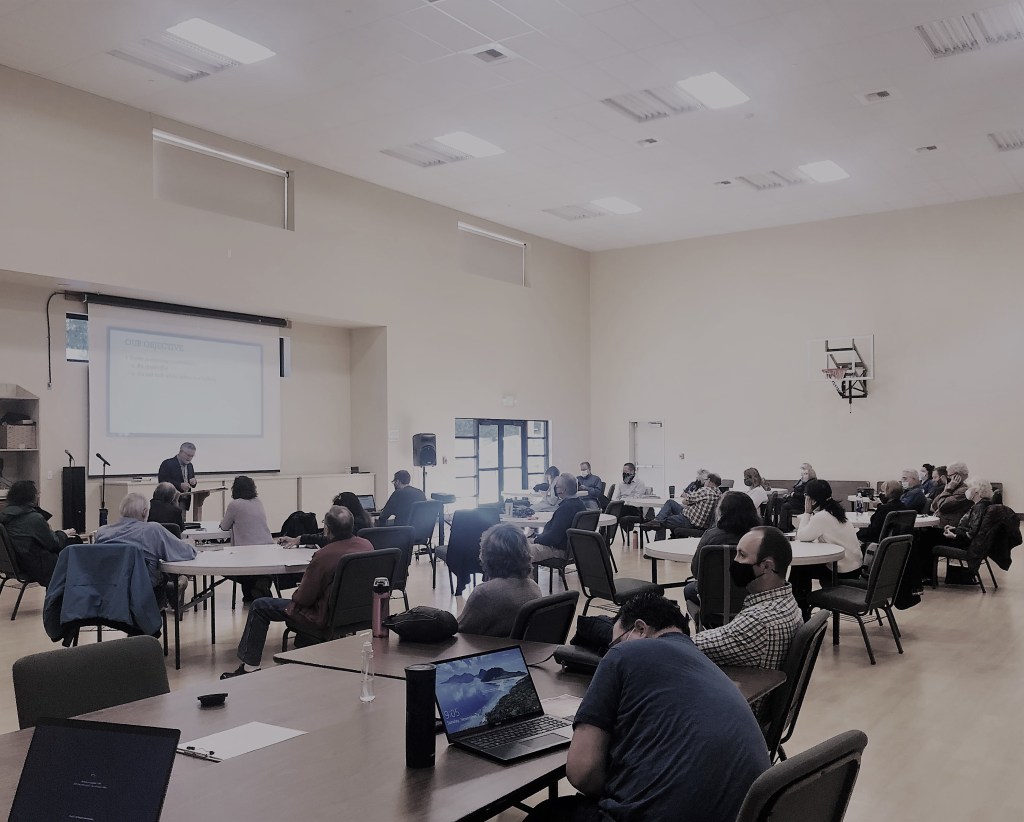
The topics we’ll be looking at in this class have been hot button issues for centuries, actually, and some folks are understandably a bit nervous about participating. They aren’t sure where these discussions will lead, and that uncertainty makes them nervous. Because tough issues involve many diverse (and strong) opinions, they are wary of the tension the class will involve as we work our way through the material.
They aren’t sure they want to sit with that discomfort.
When a couple has an argument, one may want to fix things RIGHT AWAY. Sure, it’s important to talk things out and resolve issues, but often, that person’s motivation has more to do with their discomfort in conflict, or their need to control, than in a desire to resolve the issue for the well-being of the relationship.

It doesn’t feel good when you and your partner are at odds with each other. We want to make it all better – right now.
The problem with demanding to talk things out immediately is that things can’t always be resolved right away. Sometimes the other person needs time to think, or both need to cool off a little.
Sometimes we have to sit with the discomfort for awhile.

Our world is facing a lot of uncertainty and change right now. Many people are anxious, worried.
Anxiety/worry is primarily driven by fear – of something.

One thing we humans struggle with the most is change, and we seem to be facing a ton of change – or at least the possibility of change – right now.
Change and fear about the future always involve stress, even if the change is good. Change involves the loss of one thing and the arrival of a different thing. Change disrupts our “normal” and makes us feel off balance and uncertain, even if the change is something we really want.

Change is unsettling.
That fear of change is why domestic abuse victims frequently return to their abusers, over and over. The abuse is what they know. The fear of the unknown, of change, which leaving the abuser would involve, is greater than the fear of staying right where they are. They are familiar with the abuse, and there is security in familiarity, even in a very bad situation. It takes incredible courage and strength to make such a change.
On the surface, it may seem like the abuse victim IS sitting with discomfort. It can’t be comfortable to live with an abuser. But really, this person is avoiding the feared GREATER discomfort that they believe would come with leaving.

We’ve all heard the saying “the only thing constant is change”.
If that’s true, I wonder why we seem so upset and surprised when change comes our way.
The anxiety and discomfort so many are feeling right now is mostly attached to things we 1) didn’t ask for, and 2) can’t totally control.

Plus, unlike the root canal example, we don’t know how long our current situation (pandemic, social unrest) will last or exactly what life will look like on the other side.
It’s difficult enough when there is ONE big thing causing us anxiety. But look at what we are facing right now:
- Global pandemic!
- Job loss, and change in HOW we work!
- Social isolation (think elder care facilities, kids schooling at home)!
- Contentious election cycle!
- Racial unrest!
- Horrible fires!
- Fake news!
- Floods!
- Earthquakes!
- Looting, destroying!
- Violence increasing!
- Social outrage at, well, EVERYTHING!

I’m sure I’ve forgotten something, but you get the idea.
So you’ve got some stress, some discomfort.
And I’m asking you to sit in it.

Smack dab in the middle of that discomfort, as uneasy as that feels.
Just like a marathon runner has to train to be able to run 26.2 miles in one go, you have to develop your discomfort tolerance muscles.

I know; you want to know what’s in it for you, because sitting in a pile of discomfort doesn’t sound awesome.
It sounds very NOT awesome.
There really are benefits to becoming comfortable with discomfort:
- You’ll be facing REALITY, because life will continue to throw uncomfortable situations your way.
- You’ll be HAPPIER because you won’t be consumed with worry all the time.
- You’ll be more CONFIDENT because you will know you can face difficult circumstances.
- You’ll be more PRODUCTIVE because you will be able to focus on things other than the problems.
- You’ll become RESILIENT, able to weather the storms that life inevitably will throw at you after this one is over.
- You’ll be a more PLEASANT person to be around because you won’t always be complaining about all the discomfort all the time (note: there’s a difference between complaining and discussing.)
- You’ll be able to have RESPECTFUL, NECESSARY conversations about stressful topics with people you may not agree with.
- You’ll feel better PHYSICALLY, because I guarantee, if you are focused on discomfort and consumed with anxiety, you are feeling the stress physically – headache, stomach upset, fatigue, achiness, etc.
So, how do you learn to Sit With Your Discomfort?
- Commit to it. Decide that you are going to face discomfort head on. You’ve decided to stay and have that discussion, or participate in that class, or explain your unpopular decision, or listen to a view you strongly disagree with.
- Don’t run away. When you are in a discussion that makes you anxious, resist the urge to leave, and don’t try to shut the discussion down. Sit with the discomfort.
- You may need to set small goals for yourself. Hang in there for 5 minutes at first. Then try 10 minutes. Or maybe start with one specific situation you’re going to face rather than try to deal with all uncomfortable circumstances at once.
- Focus on listening to what the other person is saying. Listen to understand their view and their reasoning, rather than listening to respond (or to smack down).
- Be an observer of your discomfort – Identify WHAT exactly you are feeling. Ask yourself WHY this situation makes you feel this way. What are you AFRAID will happen? What would you do if that DID happen? Pay attention to what your discomfort is all about.
- Practice being uncomfortable (I know how ridiculous that sounds.). If you want to practice this skill, pick a TV show or news program that you can’t stand. Then make yourself sit there and watch it, without judgment. No, really! I want you to watch it MINDFULLY, like a reporter would, setting your judgments aside. For example, instead of judging the show or the people on the show, observe and narrate what you are seeing/hearing. Instead of telling yourself, “These people are such idiots! No wonder the country is in a mess! This just makes me so angry/scared/disgusted!”, try saying this instead, “Hmm. They have come to some really odd conclusions. They seem to believe xyz because abc; I see that very differently. They seem to not have any patience for people who disagree. They are so angry! This is really hard to watch, but I’m going to hang in there.”
- Keep a journal of your daily experiences with discomfort and see how you are doing. Jot down what made you feel discomfort/anxiety, what emotions you felt and why, what actions you took, what you did well, what you would like to do differently next time.
- Get some exercise – moving your body regularly will help you get rid of some of the physical stress you are carrying around, plus create some “feel good” chemicals that fight that anxiety.
- Get enough sleep – getting enough sleep really does make a difference in how you feel and how well you process stress.
- Eat healthy foods, not junk. You knew this was coming, didn’t you? Your body needs proper fuel to function well. We Americans tend to fuel our bodies with things that don’t help us live our best lives.
- Remind yourself that you don’t have to figure everything out RIGHT NOW, even if it feels like you do.
- Acknowledge that other people have a right to their views just like you do. You may never reach agreement with the “other side”, but that is OK. Agreeing to disagree is often a reasonable solution.
- Remember that discomfort is a feeling, and you can survive it.
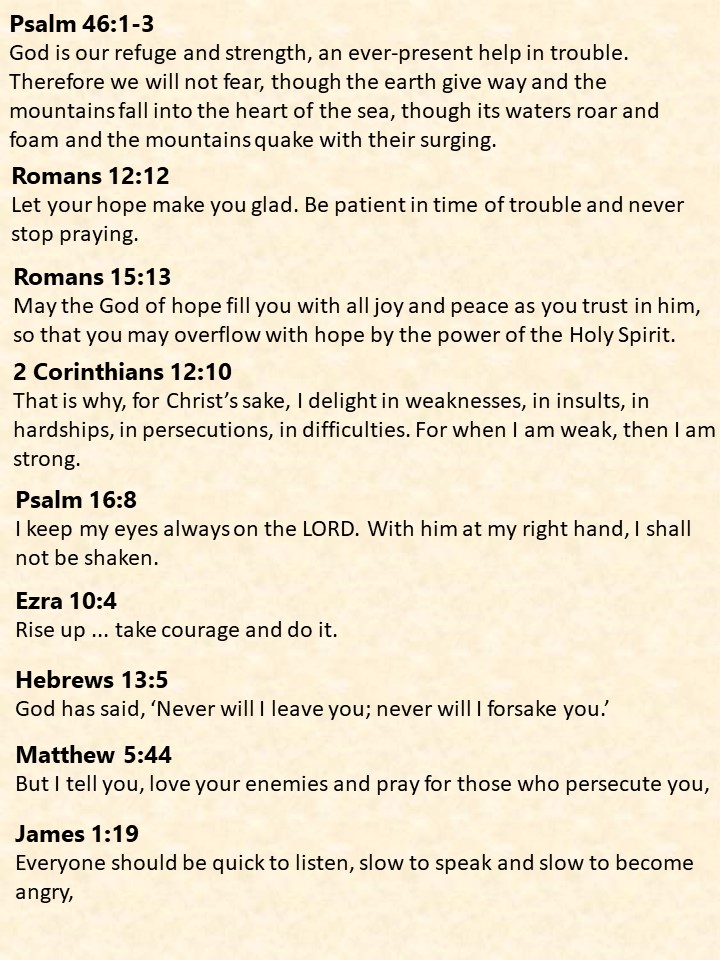
- Look to your faith for help and advice on endurance, hope in times of trouble, strength, peace, and loving others. I’ve listed some Bible passages at the bottom of this post that I find especially helpful.
- Pray – tell God what you’re feeling and what you’re struggling with. Thank Him for what He’s done. Ask him for wisdom, endurance, peace, patience, or whatever it is you need. Yes, he already knows, but it’s good for us to share these things with our Creator, plus He tells us He wants us to come to Him with our desires (Matthew 6:8 “…your Father knows exactly what you need even before you ask him!“). It makes our relationship with God much more intimate to share our heart with Him.
- Give yourself credit for every little bit of progress – this is not easy to do!
Important Note: I am not advocating that you stay in an abusive, disrespectful, or dangerous situation. That’s not the type of discomfort I’m talking about. “Sitting With Discomfort” applies to situations that make you nervous, anxious, uncertain, or scared because of your own internal struggles dealing with conflict, anxiety, or difficult discussions. If it’s dangerous, disrespectful, or abusive, get out of there!
We have so much tension in our world right now. I’m ready for some relief, and I know you are too. But in the meantime, we can use this season as an opportunity to strengthen our coping muscles. If you are having trouble dealing with the discomfort and anxiety of all this chaos and all the unknowns, I hope and pray you will commit to practicing the skills and habits that allow you to let go of some of that stress!
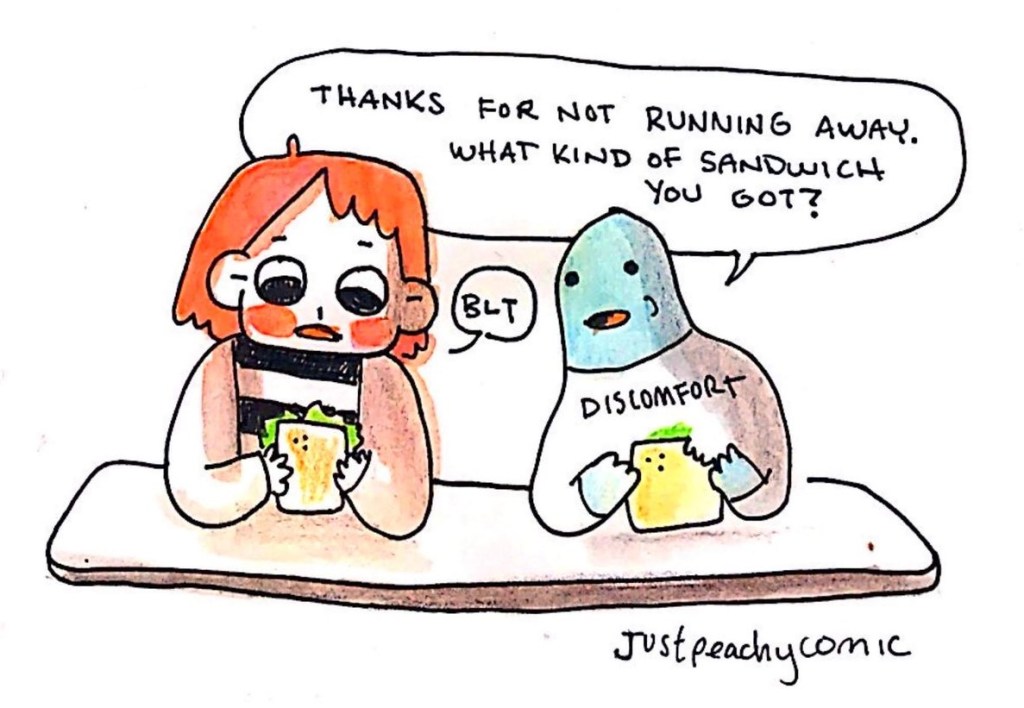
Until next time…


 Peripheral Wisdom