
THREE (4) THINGS ABOUT… PATIENCE
Earlier today, a friend of mine was telling me about the preparations she was making for some upcoming daycare evaluations by the state licensing board. The conversation was going along pretty much as you’d expect.
But then she started talking about coloring. And soup.
She was concerned about the negative impact many of the newer regulations have on children’s abilities to learn important “soft” skills, like patience and perseverance. In an effort to prevent abuse (which we certainly want to prevent), child care providers are told not to force the kids to do things they don’t want to do. If they are coloring and they become frustrated and want to do something else, you are to calmly redirect them to something they feel like doing.
That’s all well and good, but we are talking about TWO and THREE YEAR OLDS here. People who have reaaaallllly short attention spans and a lot of potential for – but as yet unrealized – patience. How many 2 year olds do you know who make mature decisions on a consistent basis about how to use their time and efforts?
Even mature 2 year olds are still TWO.YEARS.OLD.

Coloring teaches a child patience, perseverance, self-control, self-confidence, and seeing a task through to the end, in addition to many other things. My friend has some kids who don’t like to color, and she isn’t supposed to require that they keep coloring when they tire of that task. So she has to look for other kid-friendly ways to teach important life skills, like patience.

Enter soup.

Her kids like soup. And eating soup can teach a kid (or an adult) patience. If you eat soup too quickly, and you’re not used to moving liquid in a shallow, metal device toward your mouth, you’ll make a big mess and not get as much down your throat as you’d like. So you have to slow down, learn to hold that spoon steady, and move that liquid-filled spoon to your mouth.
Soup makes you take your time.
So, this conversation got me started thinking about patience: How important it is, how much we WANT patience but don’t want to do the work it takes to develop patience, and how our impatience adds so much stress to our lives (and the lives of those around us).
So grab a bowl of soup and some crayons, and think about these
THREE (4) THINGS ABOUT… PATIENCE:
1. Patience is something you have to develop (that means WORK ON…)
Here’s a great definition of patience: to endure discomfort without complaint.
 If I’m taking too long to eat my delicious chocolate ice cream on a hot summer day – I am not being patient I am having a great time. I have neither discomfort nor complaint. It tastes GOOD, and I’ll make it last just as long as I can.
However, if I am late for work, and need to fill my car with gas on the way, and all the pumps are being used right now, I have an opportunity to be patient. Waiting for a pump to open up when I know I need to hurry it up and get to work involves DISCOMFORT. If I endure this without complaint, I am being patient. If I wait for a pump, but am fussing and fuming the whole time – not patient.

To endure discomfort without complaint doesn’t mean that you get all Pollyanna-ish and pretend that everything is just peachy. You simply choose not to focus on the discomfort. You are running late and you need gas. That is true whether you fume about it or not. So why not, instead, occupy your thoughts with other things until the discomfort passes.

In the gas station example, your (loudly) mumbled complaints and those glaring looks you give the drivers who are ever so slowwwwlllllyyyyy filling up their tanks won’t make them move any faster. If anything, it will make them go SLOWER.
So why get all bent out of shape?
It is what it is. Try occupying your thoughts with something that isn’t stressful. You’ll pump the gas when you pump the gas. Call your boss and tell him/her you are running late. Being impatient does nothing good, and brings stress and angst instead. The situation is what it is; deal with it.
Got it?
Every time you are faced with a situation where you feel IMpatient, you have an opportunity to work on becoming more patient.
Over time, the act of being patient will take less effort and cause less distress. One day you will realize, “Hey! I’m pretty much a patient person now!” But the change is slow and methodical, like a moth changing into a butterfly.
When you first decide to do something about your impatience, it will take a ton of work. Just like anything else that’s worth doing, learning patience takes time and effort. And there will be times when you blow it. When that happens, just deal with the damage and begin again. It really is worth the effort.
2. If you pray for more patience, you will be given opportunities to DEVELOP patience, not receive an immediate transformation into a patient person. Sorry…
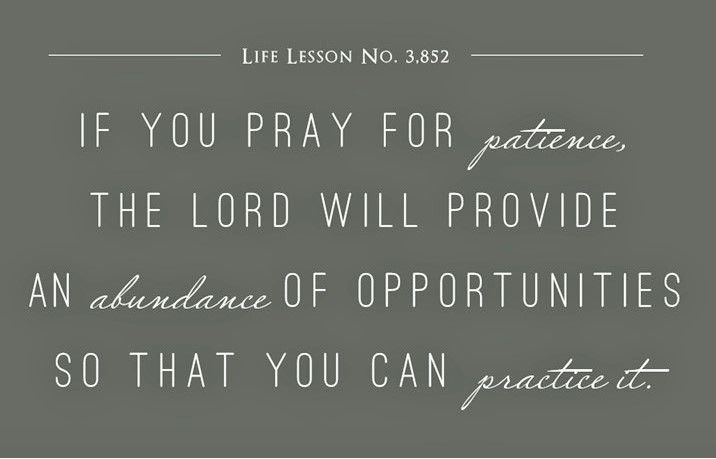 God has a great sense of humor. When you pray for patience, He will make sure you have ample opportunities to develop that character trait. I think patience is a great thing to pray for – and it’s one of the Fruits of the Spirit, so patience is certainly something we as Christians should be striving for. Just be ready for God to answer that prayer with lots of practice drills.
3. You have to CHOOSE to be more patient.

You know the feeling. When you need to buy just one thing at the grocery store and the lines (even the express checkout) are ridiculously long. You feel your dissatisfaction start to rise.
Basically, we Americans simply hate to wait. For anything.
 But there are times when waiting is the only option. And each time you are faced with that feeling of impatience starting to rise in your chest (or wherever you feel it – I feel mine in my chest), you get to decide what to do with it.
I take a deep breath, tell myself what’s up (“The lines are long. I’m gonna have to wait. It’s ok.”), and settle in for the wait. Sometimes I people watch. Sometimes I check my email. Sometimes I just space out. But I choose to NOT keep reminding myself how much I wish the line would just move along, or that lady would get the credit card chip process right, or the checker would stop talking to that person WHO IS ALREADY DONE. And you know what? I hardly ever feel that surge of impatience anymore.
Why is it so hard to be patient?
There are a few reasons. First, I believe it’s because we are so painfully and forcefully aware of our own feelings, needs, and perceptions. I can UNDERSTAND your struggles, frustrations, and your efforts. But I can only FEEL my own. So my needs feel more real, more urgent than I can imagine yours do. And so we want what we want, when we want it. And become uncomfortable when we have to wait.

Also, we seem to be able to convince ourselves that other people are trying to make life harder for us on purpose. That they aren’t really trying their best, we believe. When in reality, most folks ARE doing the best they can – we simply have unreasonable or unrealistic expectations of them. So we get angry and impatient when we think they should be doing things better, faster, “my way”.
Ever try to teach a kid long division who isn’t quite ready for long division yet? It’s hard not to get frustrated – impatient – with him, because we believe that if he would just TRY HARDER, he’d get it. Instead of getting irritated, why not make a choice to look at the situation differently: maybe that kid IS trying their best and we are just being unrealistic and impatient. Your patience may even bring the stress level down enough that the child can focus better and WILL finally get it.
And third, we have unrealistic expectations about life in general. We assume that life is supposed to be smooth sailing, that things SHOULD go our way, that others should cooperate with our needs and wants. And life really isn’t that way much of the time. So we get angry and impatient.

4. BONUS: Patience brings you (and everyone around you) more peace
Have you ever had to spend much time with a person who always complains? People who complain tend to be really impatient. Being around a person who is continually griping at the traffic, at the speed with which people do things, with the service at restaurants: it gets old fast. Being around an impatient complainer is stressful, discouraging, and crazy-making. I don’t think anyone says, “Hey! I think I’ll hang out with an impatient complainer today. It’ll be fun!”
When you feel impatient, what should you do?
You choose to calm down. Calm your thoughts, calm your breathing, calm your expectations.

Practice patience in ways both large and small:
- Read that book to your 3 year old – for the 10th time – without being frustrated
- Give the slow person the benefit of the doubt
- Always have something with you (phone, book, Sudoku, etc), so that when you have to wait you will have something to other than fume
- Find some humor in what’s happening
- Talk to God while you wait
Or you could practice coloring or eating soup.
 If you consistently practice being patient, you will one day find yourself not really being bothered by the frustration of impatience much anymore.
Prayer and meditating on Scripture require you to develop patience, too. You can’t adequately do either one, quickly. You have to take your time, make it purposeful. And in the process, you develop more purposeful patience.

Here’s something to think about: Jesus most likely totally understood the concept of patience. This is just speculation on my part, but think about it: he pounded nails into boards as a carpenter for, what, at least 10 years before beginning his ministry as SAVIOR OF THE WORLD. When you feel overqualified for your job, think about that for a minute…
Jesus had to be patient, waiting for the right time to do what he came to do. I would think that, as a human who felt all our emotions, there were times when he just wanted to get on with it. And then he had to deal with his disciples, who were forever NOT GETTING IT. Did Jesus exhibit patience with them? He did. Even when He occasionally scolded them for being so thick-headed, he was patient with them.

Love is patient. Loving others is one of only 2 commandments in the New Testament (the first is to love God). So patience is kind of important as a Christian. But just like anything else of value, patience doesn’t come easily. It is a discipline. We have to work at it, and WANT to work at it. We have to stop feeling so entitled to having everything go our way and at the speed we want it to go. We basically have to get over ourselves in order to be patient.
You have to be purposeful to be patient.

Patience is a choice. But to not make that choice?
Choosing impatience leads to a life of frustration, stress, and poor relationships, and is a miserable way to live, especially if you profess to represent Jesus.
How do I know? Because I had to learn to be patient. I was a classic type A personality in my younger years. Hated waiting in lines, in traffic. Hated being “slowed down” by those who weren’t as quick as I was. Edgy, not always very kind, especially if I was inconvenienced. My impatience with others made me miserable, it made everyone else miserable, and it didn’t help anything go any faster. So at some point, I decided to stop complaining and find something else to occupy my thoughts when I was inconvenienced. I practiced not caring that I couldn’t move as quickly as I wanted to. And, after putting some focused effort into calming myself down over time, I got to where I really didn’t mind if I ended up in the slowest line at the grocery store anymore. Or if I was in a hurry and traffic was snarled. Or if it was time to go home and someone stepped in the office who needed to talk. I learned to communicate my needs verbally, kindly, and not passive-aggressively, if I did indeed need to be on my way. But usually, I wasn’t really so rushed (and self-important) that I HAD to leave right then.
If I can do it, if I can become more patient, then you can too.
When you decide to stop being so impatient with your family, coworkers, friends, and the world at large, a huge cloud of stress will fade away. You’ll feel less stressed, and so will everyone in your world.

Until next time, be purposeful, and keep your eyes looking forward.
Rebecca
 Peripheral Wisdom